Thunderbolts* Easter Eggs: The Sentry's Comic Roots, The Watchtower And That Asterisk
Marvel's best-reviewed film of 2025 hid a title reveal in its own punctuation. Here are the comic references and callbacks packed into Thunderbolts*.
Thunderbolts* was the best-reviewed Marvel film of Phase 5 at 88% on Rotten Tomatoes and still finished its run at $382.4 million worldwide against a $180 million budget, which is a loss. It is also the most densely referential Marvel film since Endgame, and unusually, most of its references are structural rather than decorative. Here is the list.
The asterisk
The punctuation in the title was in every piece of marketing for eighteen months and Marvel refused to explain it. It pays off in the final act, when the film's title card is replaced on screen: the team is rebranded as the New Avengers, and the asterisk was a footnote pointing at a name change nobody could see coming. It is the most committed piece of long-form marketing-as-storytelling Marvel has attempted.
The Sentry, and everything attached to him
Bob Reynolds
The Sentry was created by Paul Jenkins and Jae Lee in 2000, and the character's premise is a hoax: a Superman-tier hero the Marvel Universe had somehow forgotten, whose power is inseparable from the Void, his own destructive shadow-self. The film adapts the psychology almost exactly. Bob's power scales with his mental state, and the Void is not a separate villain but the same person.
The Watchtower
Valentina Allegra de Fontaine's rebranded tower is called the Watchtower, and in the comics the Sentry lives in a Watchtower that sits atop Avengers Tower. The building being repurposed is the MCU's own former Avengers Tower, so the reference works on two levels simultaneously: it is a Sentry deep cut and it is the MCU reclaiming a set it had abandoned since Age of Ultron.
The shadow
The Void's effect, people being consumed and left as shadow stains, is a genuine adaptation of the character's comics visual, and the film's decision to make it a depression metaphor rather than a physics problem is the reason it reviewed as well as it did.
The team, and where each of them came from
| Character | Previously seen in | Comics note |
|---|---|---|
| Yelena Belova | Black Widow, Hawkeye | A comics Black Widow successor and a Thunderbolts member on the page |
| Red Guardian | Black Widow | The Soviet counterpart to Captain America, created in the 1960s |
| Ghost / Ava Starr | Ant-Man and the Wasp | Gender-swapped from a male Iron Man villain |
| John Walker / U.S. Agent | The Falcon and the Winter Soldier | A long-running comics Thunderbolts and West Coast Avengers member |
| Taskmaster | Black Widow | Photographic reflexes, a comics mercenary since 1980 |
| Bucky Barnes | The Winter Soldier onward | Bucky leads the Thunderbolts in Marvel's comics, which the film sets up |
| Valentina Allegra de Fontaine | The Falcon and the Winter Soldier, Black Widow | A comics S.H.I.E.L.D. figure with a notorious loyalty problem |
Bucky's arrival as a sitting congressman is the film's driest joke and its most comics-literate move at once. In the comics the Thunderbolts are a government-managed villain team, and Bucky Barnes eventually runs them. Making him a politician first is the MCU getting to the same place by a stranger route.
The callbacks people miss
- Alexei's post-heroic career, complete with vehicle-based side business, is a continuation of the domestic comedy from Black Widow rather than a new joke.
- Ava Starr's phasing is still visibly painful, which quietly maintains that the cure from Ant-Man and the Wasp managed her condition rather than eliminating it.
- Yelena's vest and utility rig echo the practical costume language of Black Widow, in deliberate contrast to the Avengers-branded gear the team is given at the end.
- The team has no insignia for almost the entire film, which is the MCU's standard visual shorthand for characters with no institutional standing.
- Valentina's media management of the finale is the same playbook the MCU has used since Iron Man's press conference: the story of what happened is decided afterwards, in front of cameras.
Thunderbolts* is a film about depression that ends with a rebrand. The two halves belong together, and that is the joke.
The post-credits scene
The post-credits jumps forward fourteen months. The team is operating publicly as the New Avengers, and there is a legal dispute over the name with Sam Wilson's roster, which is exactly the sort of paperwork the comics' Thunderbolts have always generated. Then a spacecraft carrying an unmistakable 4 insignia enters through a rift in the sky.
That ship is the direct hand-off to The Fantastic Four: First Steps, which had released weeks later in July 2025, and by extension to Avengers: Doomsday on 18 December 2026. Florence Pugh, Sebastian Stan, David Harbour, Lewis Pullman, Hannah John-Kamen and Wyatt Russell are all on Marvel's confirmed Doomsday cast list, which makes this the rare post-credits promise Marvel has actually kept.
What we did not include
Thunderbolts* accumulated a large volume of claimed background easter eggs during its run, including several supposed references to characters who have never appeared in the MCU and a widely circulated reading of the Watchtower's signage as containing hidden names. We have restricted this list to elements that are stated on screen, visible unambiguously, or grounded in documented comics history.
For what the ending actually resolves, read our Thunderbolts* ending explained, and the First Steps ending picks up the thread that ship starts.
Frequently asked
What does the asterisk in Thunderbolts* mean?
Who created the Sentry?
Why is the tower in Thunderbolts* called the Watchtower?
What happens in the Thunderbolts* post-credits scene?
Characters in this story
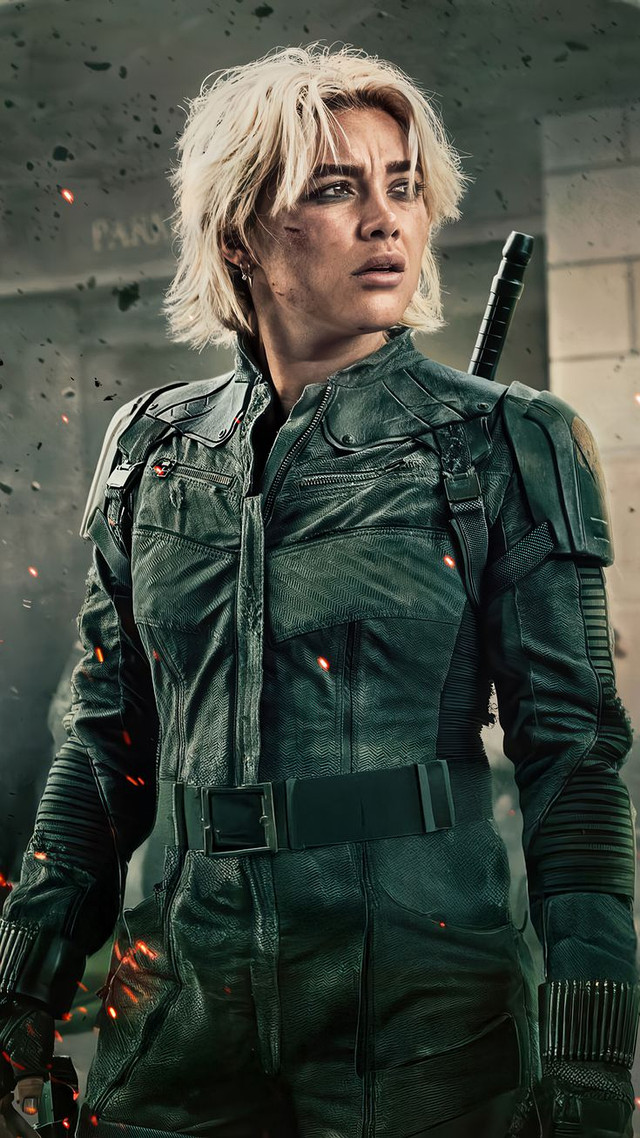
Yelena Belova
Yelena Belova

Sentry
Robert "Bob" Reynolds

Red Guardian
Alexei Shostakov

U.S. Agent
John F. Walker

Ghost
Ava Starr in the MCU; unrevealed in the comics
Catching up on the MCU? See where this fits on our full timeline.
Read next

Thunderbolts* Ending Explained: The Void, The New Avengers And That Fantastic Four Post-Credits
The team beats a god by refusing to fight him. Then Marvel changes the film's title on screen. Here is the…
Guardians Of The Galaxy Vol. 3 Easter Eggs: Every Comic Reference In Marvel's Saddest Film
Batch 89, Counter-Earth, Phyla-Vell and a talking dog. Vol. 3 is stacked with comics deep cuts, and almost all of…
The Fantastic Four: First Steps Ending Explained: Galactus, Franklin And The Doom Mid-Credits Tease
One year on from Marvel's biggest 2025 film: how the Fantastic Four actually beat Galactus, what Franklin Richards…